Why carbon dioxide ends your breath-hold
Your body has no reliable sensor for low oxygen. What it monitors closely is carbon dioxide. As CO₂ rises in your blood, chemoreceptors in the brainstem push harder and harder for a breath: first as a vague unease, then as involuntary diaphragm contractions, then as an urgency that feels impossible to argue with.
The urge to breathe comes from rising CO₂, not from a lack of oxygen. For a trained freediver at two or three minutes, oxygen is usually still fine. The hold ended because the alarm got loud. CO₂ tolerance training makes that alarm quieter and later — without ever removing it, because the alarm is also what keeps you safe.
The core idea
Training tolerance means repeatedly starting a hold with CO₂ already elevated. The rest between rounds is deliberately too short for levels to return to baseline, so every round begins further along the curve than the last. Do that consistently and your body and mind learn to stay calm with sensations that would make most people panic.
A later first contraction
The point where your diaphragm starts twitching moves further into the hold as your sensitivity to rising CO₂ drops.
A longer struggle phase
Contractions stop meaning "the end". You learn that a comfortable minute often sits on the other side of the first few.
Lower oxygen burn
Less panic means less tension, a slower heart rate, and less oxygen spent on fighting your own body.
Gert walks through what a CO₂ table is, how to build one, and how to progress it over time.
The mistake almost every beginner makes
CO₂ training is as much mental as it is physical — for beginners, even more so. And the standard beginner question is the wrong one.
People ask: how much rest should I have between holds? Wrong focus. The rest intervals are not what moves the needle. What moves the needle is the mental shift that lets you relax more as the rest gets shorter. Ask that question instead — how can I be even more relaxed during this table? — and the times take care of themselves.
How to train it
- CO₂ tables Holds with limited recovery in between, so each round starts with elevated CO₂. Three tables to start from are further down this page.
- Breathing protocols with no hold at all Reduced-volume breathing and extended exhales raise CO₂ gently and can be done on the days between tables, with far less fatigue.
- Empty-lung holds Short holds after an exhale reach a strong CO₂ signal quickly. Powerful, but demanding — these belong later in a progression, not in week one.
- Walking or movement holds Gentle movement raises CO₂ faster and rehearses staying calm while the body is working.
CO₂ table or O₂ table?
CO₂ table
You train tolerance to carbon dioxide. The rest stays short, so CO₂ never fully clears and the urge to breathe arrives earlier in each round.
O₂ table
You train your threshold to low oxygen. The rest is long enough for CO₂ to return to baseline, but the repeated holds drive oxygen down. More demanding, and not where beginners should live.
One more thing worth saying, because it causes a lot of confusion: not every breath-hold table is a CO₂ table. A complete training program also includes other types, progressive breath-hold tables among them. Everything below is specifically about CO₂ tables.
Three tables to start from
These are examples, not the only options. If you're a beginner, start with the one-breath 10 × 0:30 and tweak from there. If you think you can handle 3 × 2:00, start there instead. Eventually you get to the two-breath 5 × 1:30. The three are interchangeable — rotate between them and adjust them to your level.
Easiest starting point
One-breath 10 × 0:30
Ten rounds of 0:30 holds with just one breath between each. The short holds keep it manageable while the single breath keeps CO₂ elevated throughout.
How to progress: keep one breath between holds and increase the hold. 0:30 → 0:45 → 1:00.
Timed rest
CO₂ 3 × 2:00
Rounds of 2:00 holds with a timed rest interval in between. More recovery than the one-breath version, but considerably longer holds.
How to progress: keep the hold at 2:00 and shorten the rest over time. 1:30 → 1:15 → 1:00.
More challenging
Two-breath 5 × 1:30
Five rounds of 1:30 holds with just two breaths between each. Longer holds combined with very limited recovery.
How to progress: keep two breaths between holds and increase the hold. 1:30 → 1:45 → 2:00.
| Table | Rest between holds | What you change to progress |
|---|---|---|
| One-breath 10 × 0:30 | One breath | Lengthen the hold, keep the single breath |
| CO₂ 3 × 2:00 | Timed interval | Shorten the rest, keep the hold at 2:00 |
| Two-breath 5 × 1:30 | Two breaths | Lengthen the hold, keep the two breaths |
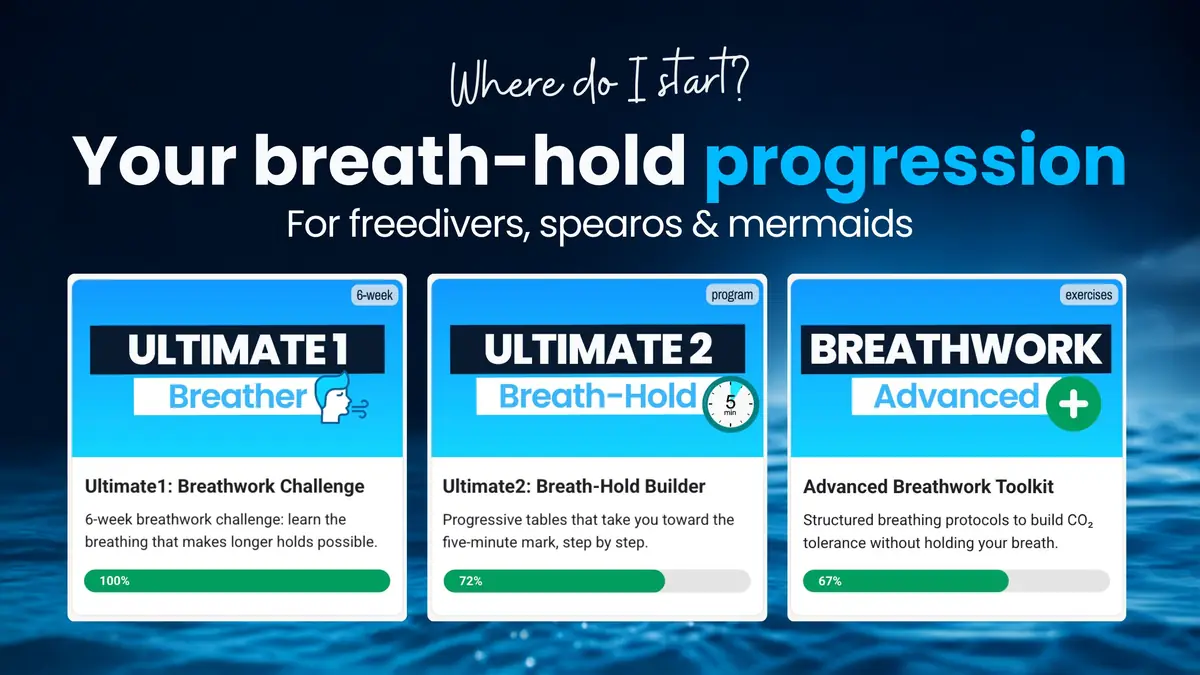
Guided versions of the full set of tables are inside Ultimate 2, the breath-hold training program in the Squad, available after your free trial. Here's a preview session you can train along with — lie down before you press play.
A preview of the guided table sessions inside Ultimate 2.
How long it takes
CO₂ tolerance responds quickly — noticeably faster than most physical adaptations. Members who train consistently usually feel the first contraction arriving later within two to three weeks, and see their maximum hold move within four to six. Doubling a starting hold inside two months is a common outcome when the work is daily and structured.
The catch is consistency. Tolerance fades if you stop, the same way conditioning does. Fifteen minutes most days will always beat one heroic session a fortnight.
Peace in every breath
Freediving isn't really about chasing numbers. Holding your breath teaches you to become comfortable with the uncomfortable, and CO₂ tolerance is a physical skill and a metaphor at the same time. You practise staying calm while something inside you insists there's an emergency. That transfers directly into the rest of your life.
Where to start
Start with breathing, not with holds. CO₂ tolerance begins with breathing correctly — the breathwork foundation comes before any table. Once that's in place, the five stages of a hold tell you what you're feeling and when. If tables feel brutal rather than uncomfortable, that's usually the sign the foundation isn't there yet.