Comfort is the performance
Mermaid work isn't about a maximum time. It's about having so much margin that you can smile, swim, pose and hold eye contact with a camera without any part of you counting down. That margin comes from CO₂ tolerance and relaxation — the same two things every freediver trains, pointed at a different goal.
Unhurried holds
When 45 seconds sits comfortably inside a three-minute capacity, everything above the surface reads as calm.
Facial relaxation
Tension shows first in the jaw and eyes. Dry practice is where you learn to soften the face while contractions come.
Repeatability
A shoot is dozens of takes. Four active recovery breaths between them keeps take twenty as good as take two.
Training that fits a shoot schedule
Fifteen minutes a day, dry, on a mat. No pool time needed to build the tolerance — pool time is for the swimming, the tail and the choreography. Keep the CO₂ sessions away from shoot days; arrive rested and the holds feel easy.
- Start with breathwork Daily breathing before you chase any number. See freediving breathwork.
- Add CO₂ tables twice a week Structured tolerance work. Start from the three CO₂ tables.
- Know the stages Learn what happens at each phase of a hold so nothing surprises you mid-take.
- Rehearse recovery The breathing between takes is what protects you across a long day.
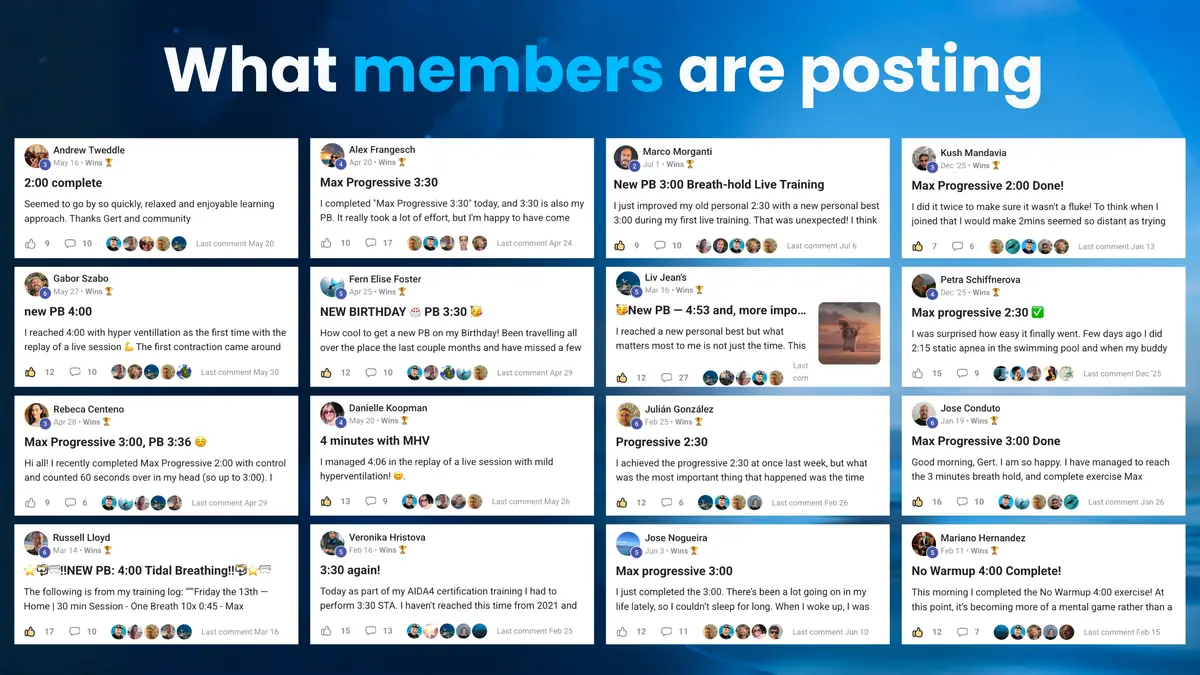
Mermaids train alongside freedivers and spearos inside the Squad — the fundamentals are identical, and the community is a mix. Have a look at what members are posting.